


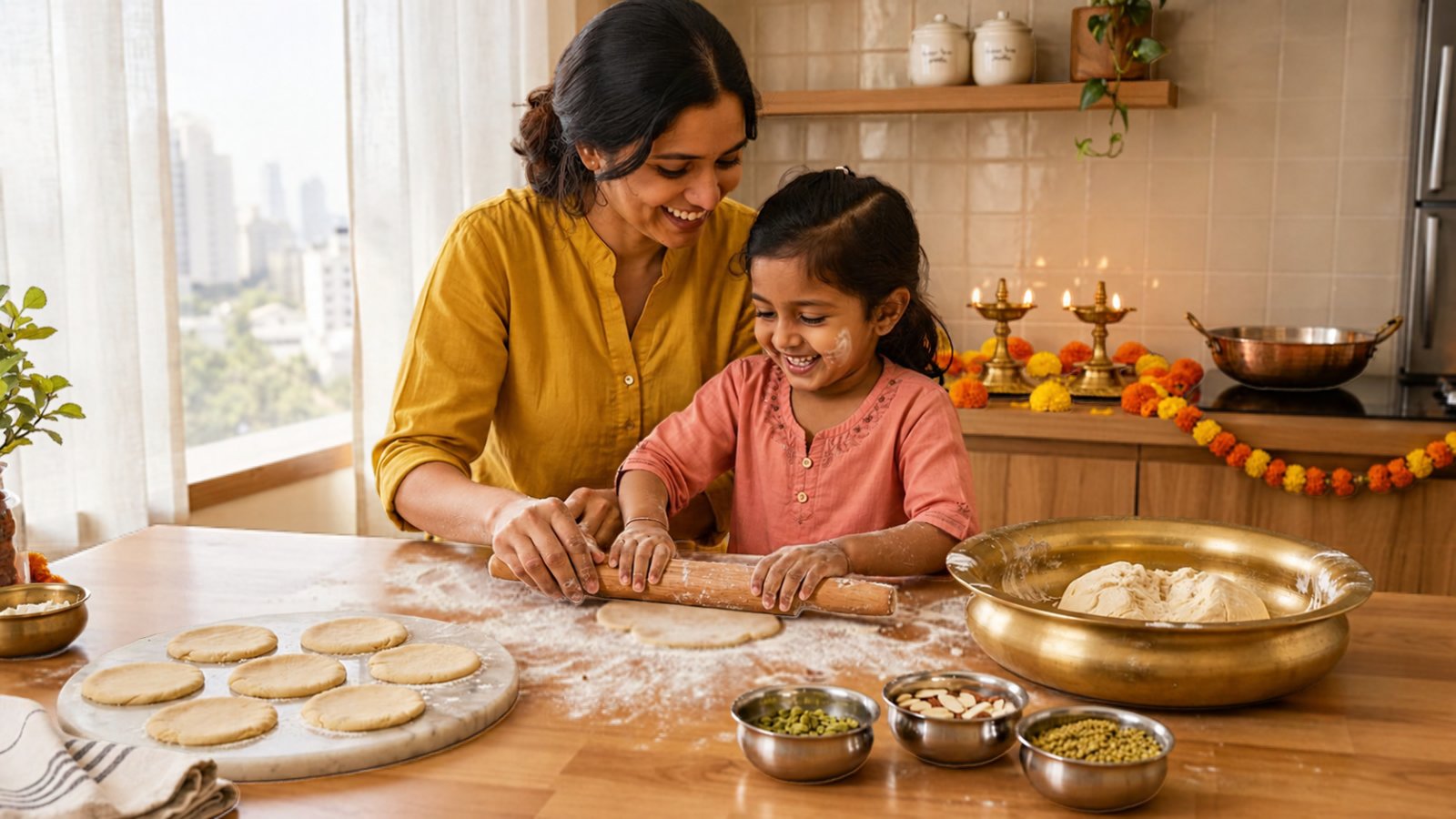
Between school runs, office deadlines, long commutes and flats that are nowhere near the family village, it can feel like there is no room left for rituals. Yet most of us want our children to know what a festival means, not just that it means a holiday. If you are wondering how to go about keeping traditions alive with kids in a busy city life, the good news is that it does not take a grand celebration. Small, repeatable habits do most of the work.
This guide is practical rather than perfect. You will find simple weekly rituals, ways to tell festival stories, a family recipe project, ideas for including grandparents by video call, tips for celebrating other communities’ festivals, greener ways to celebrate, and a planner table to help you look ahead through the year.
Why keeping traditions alive with kids matters
Children love knowing what comes next. A ritual gives a day a shape: we light a lamp in the evening, we make this sweet before that festival, we call Nani on the morning of the big day. That predictability is comforting, and it is also how a child slowly builds a sense of “this is what our family does.”
UNESCO describes this kind of living heritage as traditions “inherited from our ancestors and passed on to our descendants”, and it lists festive events and traditional skills among them (UNESCO, What is intangible cultural heritage?). In other words, traditions survive only when someone shows them to the next generation, and in a city home, that someone is usually you.
A few things rituals can quietly give a child:
- Belonging. They connect your child to grandparents, cousins and a larger family story.
- Language and vocabulary. Words like aarti, rangoli, pookalam or sadya arrive naturally, in context.
- Values through practice. Sharing sweets, welcoming guests, thanking nature and respecting elders are easier to learn by doing than by lecture.
- Happy memories. The smell of a sweet frying or the sound of a bell tends to stay with a person for life.
It also helps to be honest about what you can manage. A tradition done simply and with joy beats an elaborate one that leaves you exhausted and the children bored.
Start with small weekly traditions
Festivals come only a few times a year, so weekly habits are what keep the thread alive in between. Pick one or two that suit your home and stick to them for a couple of months before adding more.
Ideas that fit a busy week
- A lamp or diya in the evening. Let your child light it with supervision and say a short prayer or a “thank you for today” in your own words.
- One shloka, prayer, lullaby or folk song a week. Learn it together and sing it at bedtime. Keep it short enough to be remembered.
- A Sunday family meal. Cook one regional dish from your side of the family, and let the children name the dish and its home state or town.
- Rangoli, kolam or alpana on a fixed day. A simple chalk or flower pattern at the door takes five minutes, and small hands can help.
- A “story night”. One evening a week, read or tell a story from the Panchatantra, the Ramayana, the Mahabharata, a folk tale from your region or a story of your own community.
- A family story at dinner. Ask a grandparent or uncle to share how a festival was celebrated when they were small, and let children ask questions.
If your family follows a different faith, the same idea works with your own practices: a weekly prayer time, a Friday family meal, a Sunday gathering, a hymn or kirtan evening, whatever is meaningful in your home.
Telling festival stories children actually listen to
Most of us know the headline of a festival, but not always a story we can tell in two minutes. A child does not need a full scholarly account. They need a story with characters, a bit of drama and a point.
Some tips that help:
- Keep it short and vivid. Four or five sentences, then let the child ask questions. Add a sound effect or a gesture if it helps.
- Say where the story comes from. Many festivals have different stories in different regions. It is perfectly fine to say, “In our family we tell it this way, and in Gujarat or Bengal people tell it differently.”
- Connect it to the child’s own life. If the festival is about light and new beginnings, ask what is one thing your child wants to do better this year.
- Use things you can see. A diya, a flower, a sweet or a drawing makes the story easier to hold on to.
- Let older children retell it. A six-year-old telling the story to a younger cousin remembers it far better than hearing it a third time.
If you do not know the story, that is fine. Ask a grandparent, borrow a book from the library, or read it together and say honestly, “Let us find out.” Children value that kind of curiosity.
Cooking a family recipe together
Food is often the easiest tradition to pass on, because it needs no background knowledge, only an apron. A festival sweet or a Sunday dish that has travelled through your family is a story you can eat.
How to make it work in a small kitchen
- Pick one recipe, not ten. A single dish that your child associates with a festival is enough to begin with.
- Give age-appropriate jobs. Little ones can wash grains, sort lentils, press dough shapes or sprinkle toppings. Older children can measure, knead and stir. Keep hot oil, boiling sugar syrup and sharp knives for adults.
- Write the recipe down. Ask the grandparent who knows it to dictate it, and note the tips along with the measurements (“until it smells nutty”, “until the dough feels soft”). Keep it in a notebook that can be passed down.
- Record a short video. A phone clip of a grandmother stirring and explaining is worth more than any printed recipe.
- Be flexible about the result. The first attempt may be lopsided. Eat it with pride anyway.
If your child has a food allergy, check every ingredient and adapt the recipe, and ask your child’s doctor if you are unsure what is safe.
For a hands-on festival food project, our edible rakhi idea for Raksha Bandhan is a gentle place to begin with small children.
Include grandparents by video call
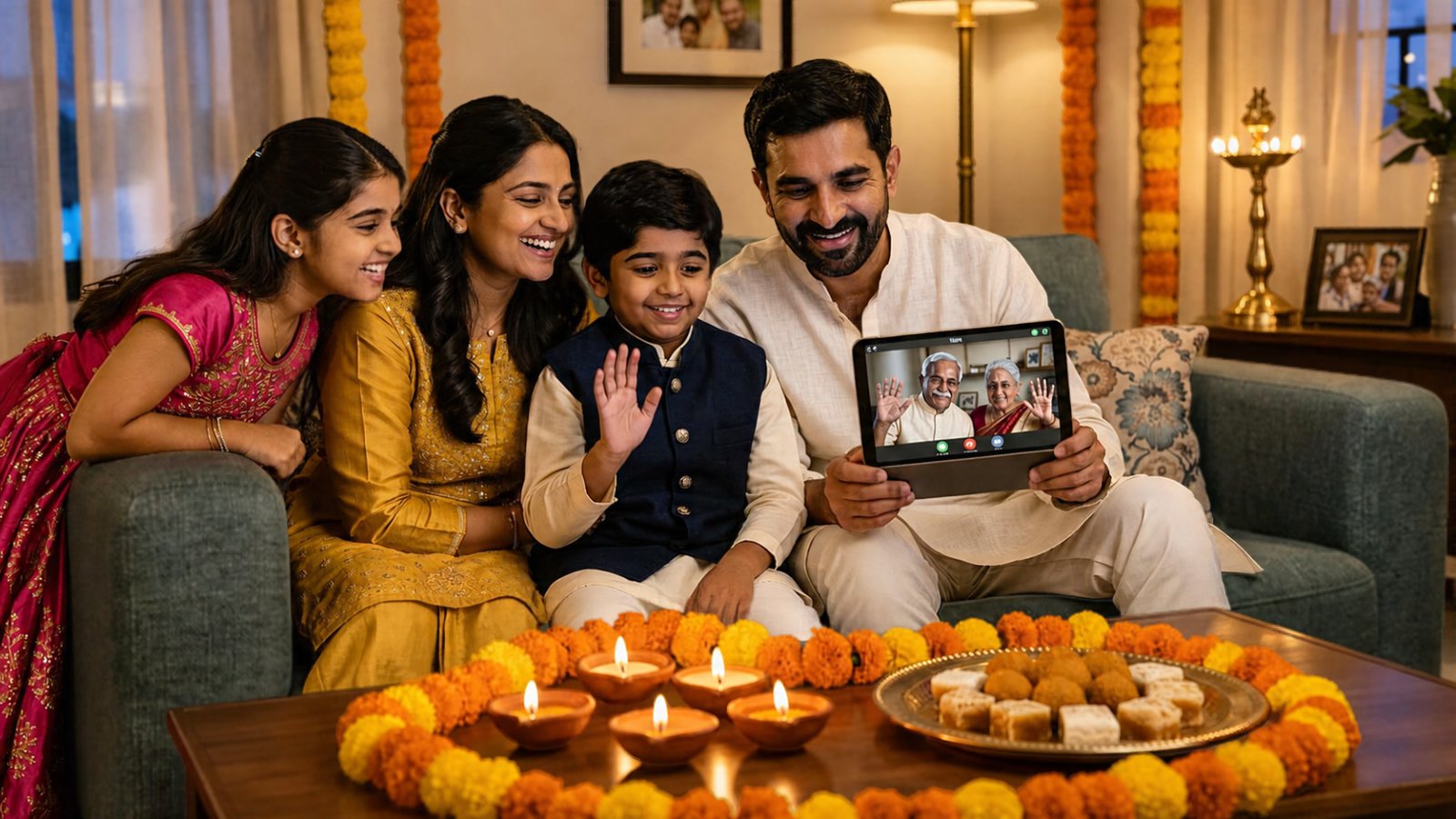
Many families now live in different cities from their elders, and a festival can feel very quiet without them. A video call will not replace a hug, but it can bring them into the ritual rather than leaving them on the sidelines.
- Give them a role. Ask a grandparent to tell the festival story, teach a song, or guide you through a step in a recipe or puja while you follow along.
- Fix a time. Agree on a slot that works for both sides, such as the morning before the main ritual or the evening aarti. Elders usually like knowing exactly when to expect the call.
- Prop up the phone or tablet. Place it where they can see the table, the lamps or the kitchen, instead of holding it in a shaky hand.
- Let children show something. A drawing, a rangoli or a dish they helped make gives the call a purpose beyond “How are you?”
- Save the call. If everyone is comfortable with it, record a short clip. Years later it can become a treasured keepsake.
- Help them with the technology. A quick message with a link or a short note on how to answer the call makes a big difference for elders who are not comfortable with apps.
Not every grandparent is available or well enough to be on a call. If that is the case in your family, a short voice note or a letter from the child works just as well.
Celebrating other communities’ festivals respectfully
Children in Indian cities grow up in classrooms and housing societies with friends from many backgrounds. Learning about each other’s festivals is one of the best ways to build respect.
- Learn before you join. Ask your friend or neighbour what the festival means to them, what is appropriate to wear and what you should know before visiting.
- Accept the invitation graciously. Eating the sweets, wearing festive clothes and offering greetings are usually warmly welcomed. If a ritual is not meant for guests, simply watch respectfully.
- Do not turn it into a costume. Explain that a festival is something people hold dear, not a theme party.
- Check dietary needs. If you are cooking for a friend’s family, ask about vegetarian, halal, Jain or other food needs first.
- Share your own too. Invite neighbours for Diwali sweets, Holi with safe, skin-friendly colours, Christmas cake or Eid sheer khurma if you celebrate them.
Our guide to Bakrid traditions and crafts for Eid is a friendly way to introduce children to a festival they may not celebrate at home.
Make celebrations kinder to the planet
Many traditions began as ways of living in step with the seasons and with nature, so eco-friendly choices fit them well. You do not have to change everything at once. Try one swap each festival.
- Natural decor. Marigold and mango leaf torans, flower rangoli and clay diyas are traditional and can be composted or reused.
- Safe, natural colours. For Holi, look for skin-safe colours or make your own from flowers and herbs, and test on a small patch of skin first.
- Clay idols. For Ganesh Chaturthi or Durga Puja, consider clay idols from local artisans and follow your city’s guidance on immersion. Check your state pollution control board or municipal corporation for the rules in your area.
- Cut down on crackers. Many families celebrate with lamps, sweets and games instead. Where crackers are allowed, local rules differ, so check them first.
- Reuse and upcycle. Handmade gift wrap, cloth bags and recycled craft decor are cheaper and more personal.
- Less waste on the table. Use steel plates, banana leaves or reusable cutlery for gatherings.
We have more specific ideas in our posts on an eco-friendly Diwali and on celebrating Diwali with kids.
UNESCO added Deepavali to its Representative List of the Intangible Cultural Heritage of Humanity in 2025. Its description notes that knowledge of the festival is passed down informally across generations (UNESCO, Deepavali). That is a nice thing to share with children when you explain why a festival matters beyond the holiday.
A festival-year planner for busy families
Dates for most Indian festivals follow lunar or regional calendars and shift every year, so this planner lists the season rather than a date. Check a trusted calendar for the exact dates each year and put them on your phone a month ahead.
| Festival | Where and by whom it is widely celebrated | General season | A simple kid-friendly activity |
|---|---|---|---|
| Makar Sankranti, Pongal, Lohri | Across India under regional names; Pongal in Tamil Nadu, Lohri in Punjab | Winter, around January | Make til-gud or pongal together; talk about the harvest |
| Holi | North India and widely across the country | Late winter to spring | Make flower colours; hear the story of Holika and Prahlad |
| Eid | Muslim communities across India | Follows the Islamic lunar calendar, so it moves through the year | Craft Eid cards; share sweets with neighbours |
| Raksha Bandhan | Many parts of India, between siblings | Monsoon | Make handmade rakhis; write a note to a sibling or cousin |
| Ganesh Chaturthi | Especially Maharashtra, Goa and Karnataka, and by families across India | Late monsoon | Shape a small clay Ganesha; make modak with an adult |
| Onam | Kerala and Malayali families | Late monsoon to early autumn | Make a pookalam from flower petals; learn what goes into a sadya |
| Navratri, Garba, Durga Puja | Gujarat, Bengal and across India in different forms | Autumn | Learn a simple Garba step; draw a picture to go with the Durga story |
| Diwali | Across India and by many communities | Autumn | Paint clay diyas, make a rangoli, clean and decorate together |
| Christmas | Christian communities and many families who enjoy the season | December | Make a handmade star or tree ornament; bake together |
This list is only a starting point. India has many more festivals, such as Baisakhi, Gudi Padwa, Bihu, Janmashtami, Guru Nanak Jayanti, Mahavir Jayanti and Buddha Purnima, and your family may have others of its own. Add the ones that matter to you.
A good habit is to pick two or three festivals a year to celebrate in a bigger way and keep the rest light. That keeps the calendar from becoming a chore.
Keep it simple, keep it going
You do not need a perfect festival or a big house. Choose one weekly ritual, one family recipe, one story and one call with grandparents, and you have already begun. Children will remember the feeling more than the details, and they will pass on what they remember.
If you want a place to start this week, light a lamp this evening, sit together, and tell your child one story from your own family. The rest will follow from there.