


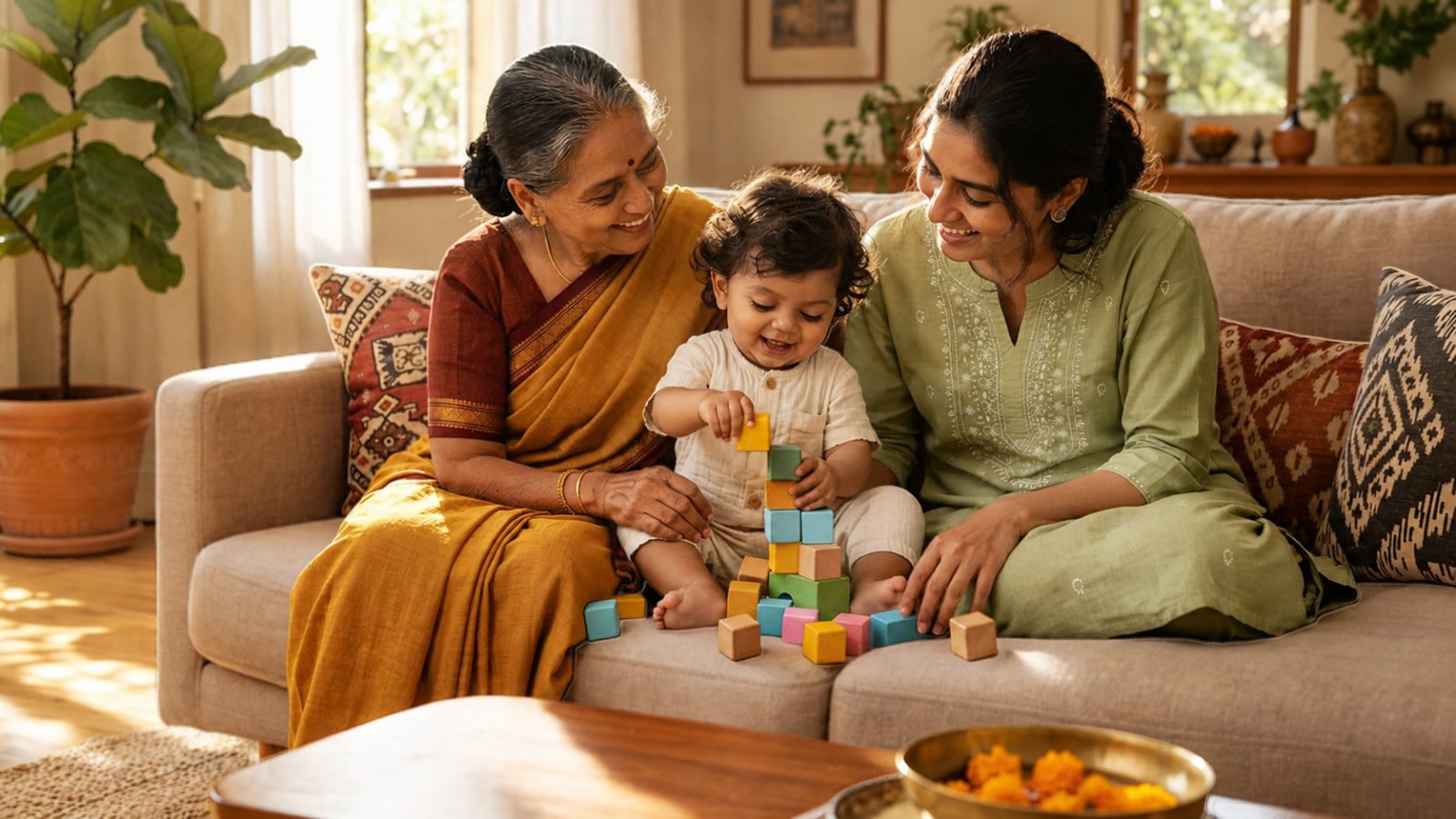
Parenting with grandparents can be the best support system an Indian mom has, and also the quickest way to feel like a guest in your own home. Whether you live in a joint family, or your parents or in-laws have moved in for a few months to help with a new baby, the arrangement works only when everyone knows who decides what. This guide is about getting there without hurt feelings.
It is not a verdict on whose generation did it better. It is a practical look at how to agree on rules, talk through disagreements, share the work fairly, and let your child enjoy having elders close by.
Why parenting with grandparents feels so complicated
Grandparents come with love, experience and free time, which is a rare combination. They also come with their own way of doing things, shaped by a different era, different homes and often very different expectations of mothers.
Most friction does not come from bad intentions. A grandmother who tops up a feed or a grandfather who offers a biscuit “just one” believes they are showing care. You, meanwhile, are trying to follow a plan you have thought about carefully. Both can be true at once.
Three things usually sit underneath the arguments:
- Authority. Who has the final say when you and your mother-in-law disagree?
- Identity. Grandparents who have raised children can feel their expertise is being questioned. Moms can feel their judgement is being overruled.
- Tiredness. Many flare-ups happen at the end of a long day, when nobody has the patience to explain.
Naming these early makes the rest easier. It stops you from treating every small clash as a character flaw in someone you love.
Start with one calm family conversation
Do not wait for a big disagreement to set the ground rules. A short, planned chat, ideally when the kids are asleep and nobody is rushing to work, sets the tone better than twenty small corrections.
Some pointers that help:
- Decide with your partner first. Agree between the two of you on the three or four things that matter most. Walking in with a list of twenty rules sounds like criticism.
- Open with thanks. “We could not manage without you, and we want to make this easy for everyone” lands very differently from “please stop doing X”.
- Ask before you tell. “How did you handle bedtime when the children were small?” invites a story. It also shows you are listening before you suggest changes.
- Keep the list short. Pick the few non-negotiables and be relaxed about the rest.
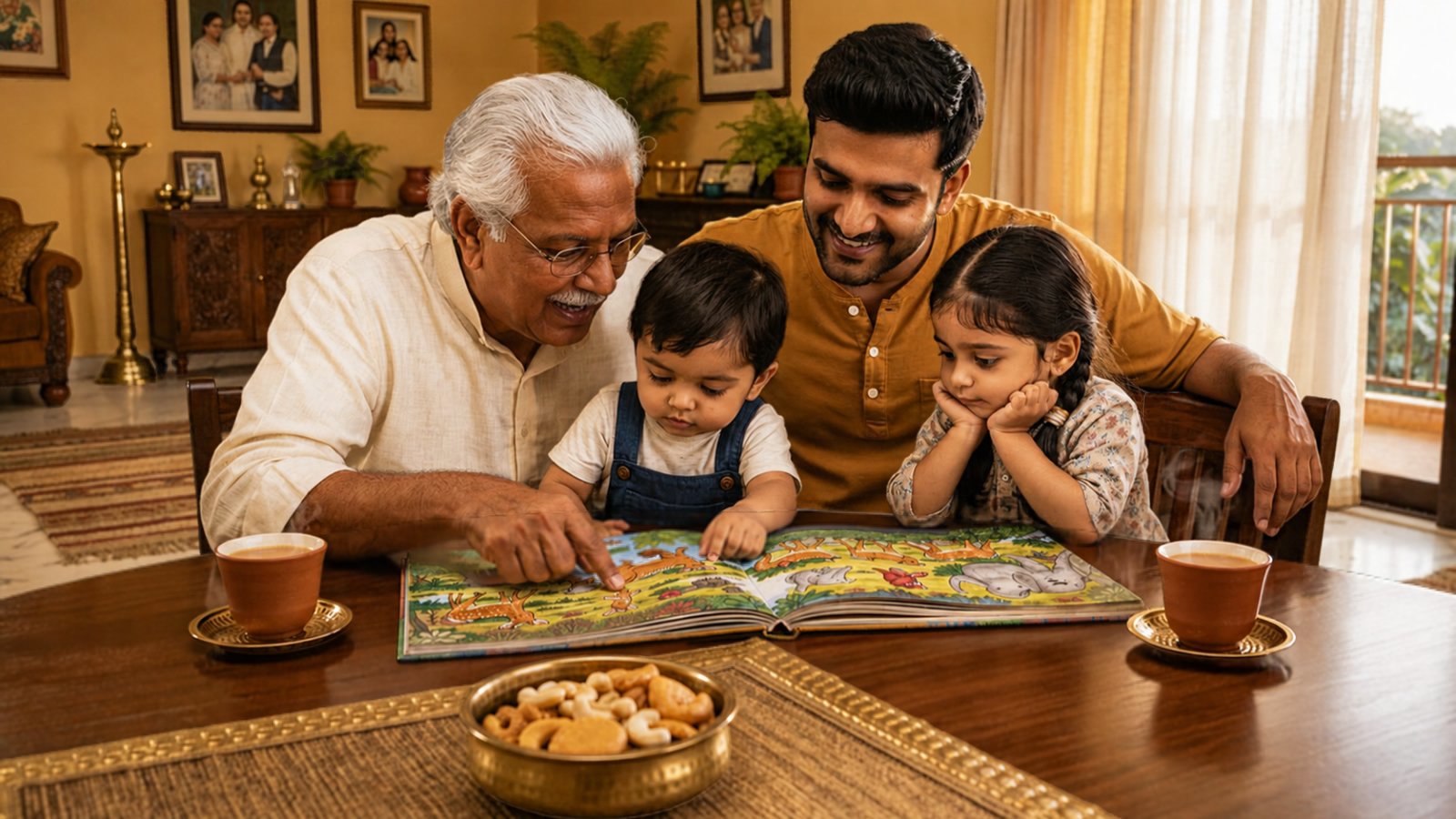
Agreeing on rules for food, screens, sleep and discipline
These four areas cause most of the disagreements. The table below is a starting point for your own conversation, not a script. Your family’s answers will differ.
| Area | Common friction | A workable middle path |
|---|---|---|
| Food | Extra helpings, sweets as a reward, following the child around to feed them | Agree on what is served at meals and what counts as a treat. Let grandparents own a “special” dish or festival sweet so they feel generous within limits. |
| Screens | A phone or TV used to keep a child quiet during meals or while you are at work | Set clear times and places for screens, and offer elders an alternative: stories, songs, carrom, a walk to the park. |
| Sleep | Different bedtimes and naps, or picking up the child at every whimper | Agree on a simple routine with fixed steps. Write it down if that helps and keep it visible. |
| Discipline | Giving in to avoid a tantrum, or stricter methods than you want | Agree that parents set the rules and grandparents back them up. No bribes, no scaring, and no undermining a “no” in front of the child. |
Food
Food is love in most Indian homes, which is why it is so emotional. Rather than banning things, give grandparents a role: a Sunday breakfast they plan, or the festival sweets they make. When the child knows that dadi’s laddoo is a treat and not a daily right, everyone is happy.
If your child has a medical need such as an allergy, share it clearly with every caregiver and follow your paediatrician’s guidance. That is not up for negotiation, and most grandparents will understand once it is explained plainly.
Screens
Many grandparents turn to a phone because it works, not because they disagree with you. The best fix is a replacement, not a lecture. Keep a basket of books, puzzles, clay or old card games where they can reach it easily.
For reference, the WHO has published guidelines on physical activity, sedentary behaviour and sleep for children under 5, which include advice on screen time. Sharing a neutral document like this can take the “mom versus grandma” tone out of the discussion. Your child’s doctor can help you apply it to your own child.
Sleep
Consistency matters more than perfection. If bedtime is the same steps in the same order, whoever is putting the child to bed can follow it. A short written routine on the fridge, such as bath, story, lights off, makes it easy for elders to follow without feeling corrected. If bedtime battles are your main struggle, our post on getting a child to sleep alone has practical ideas you can share with the whole household.
Discipline
This is the most sensitive area, so go slowly. A good rule of thumb: parents decide the rules and consequences, grandparents support them, and nobody overrules anyone in front of the child. If dadi says no to a second chocolate and mom says yes, the child learns whom to ask, not what the rule is.
If you would like a shared way of handling meltdowns, our guide to toddler tantrums is a gentle place to start. Reading it together can turn a tense subject into a joint project.
How to disagree respectfully with an elder
You will disagree sometimes, and that is normal. How you do it matters more than whether you do it. In many Indian families, speaking back to an elder feels disrespectful. You can be firm and still be respectful.
- Choose the moment. Not in front of the child or guests, and not during a rush. Wait until things are calm.
- Use “we” and “I”, not “you”. “We are trying to keep the screen off at meals” lands softer than “you keep giving him the phone”.
- Give a reason in one sentence. Long explanations feel like debates. A short, honest reason is easier to accept.
- Offer a yes alongside the no. “Please skip the biscuits before lunch, but you can give her one after” gives the elder something to do.
- Let small things go. If something is not harmful or important, let it pass. Save your energy for what really matters.
- Repeat, kindly. Change takes time. Expect to say the same thing more than once without frustration.
The way you talk to your child is also the way you model talking to elders. Our piece on how to talk to children has listening habits that work just as well with grandparents.
Your partner has to carry their own parents
One of the simplest rules in a joint family is this: each partner speaks to their own parents about difficult topics. A husband explaining the screen rule to his mother, or a wife explaining bedtime to her father, is received very differently from the same message coming from a daughter-in-law or son-in-law.
That does not mean the partner should simply take sides. It means:
- Agreeing privately first so the message is shared and united.
- Never letting a parent hear “my wife says” or “my husband insists”. It should be “we decided”.
- Stepping in quickly when something goes wrong, rather than leaving you to handle it alone.
- Checking in afterwards: “Was that hard to hear? Thank you for understanding.”
If your partner tends to stay silent to avoid conflict, say so gently and early. Feeling alone in your own home is the fastest way for resentment to build.
Give grandparents rest, credit and a real role
It is easy to treat grandparents as free childcare. But they are people with their own health, routines, friends and need for rest. Respecting that is also part of parenting with grandparents.
- Set limits on their hours. Agree on who does what and when, and make sure they have downtime in the afternoon: a walk, a satsang, or their usual TV serial.
- Don’t assume. Ask before handing over the baby so you can go out. A thank you each time costs nothing.
- Share the heavy lifting. If you have domestic help, a cook or a nanny, make sure elders are not doing physically tiring jobs unless they really want to.
- Give credit in front of the child. “Dadi taught you that song, didn’t she?” builds the child’s respect and the elder’s sense of pride.
- Give them a role that is theirs. Story time, a festival recipe, teaching a prayer or a card game, an evening walk with the child.
- Ask about their wishes. Some grandparents want a lot of time with the grandchildren, others want more space. Both are valid.
When everyone feels appreciated, rules are easier to follow. For the wider picture of keeping yourself steady in a busy household, you may also like our post on time management challenges every mom faces.
What children gain from having grandparents close
Beyond the practical help, grandparents give children a sense of belonging to a longer story. Without making any grand claims, here is what many families notice:
- Family stories and language. Songs, proverbs, recipes, and the way relatives are addressed all travel through grandparents.
- Another trusted adult. A child who knows several adults love them has more people to turn to.
- Patience and unhurried attention. Elders often have the time to listen to a long story or play the same game again.
- A model of respect. Children learn how to treat elders by watching how you do it.
- Traditions and festivals. Diwali lamps, Pongal, Eid or Christmas customs feel richer when the older generation explains why.
Children do not need everyone to agree on everything. They need the adults around them to be kind to one another and consistent on the big things. For a reliable source of child development and caregiving articles you can read together with the elders at home, see UNICEF Parenting.
When it is not working
Sometimes, despite everyone’s effort, the arrangement is stressful. Maybe there is a long-standing family conflict, or a serious difference in values on something important to your child’s safety or wellbeing.
A few steps that can help:
- Pause and decide with your partner what is truly non-negotiable. Safety and your child’s doctor’s advice come first.
- Try a trusted family member as a go-between, such as an aunt or uncle both sides respect.
- Look at practical changes, like a different daily schedule, a separate room or a shorter visit, before assuming the relationship is broken.
- If the stress is affecting your mood or your marriage, talk to a qualified family counsellor. This article is general information, not professional advice.
A short checklist to start this week
- Talk with your partner and pick three priorities.
- Plan one calm family conversation that begins with thanks.
- Write a simple routine for meals, screens and bedtime and keep it visible.
- Give each grandparent a role that is their own.
- Agree who speaks to whom when something needs to be said.
- Plan one afternoon a week when elders are off duty.
- Say thank you in front of the child, every day.
Parenting with grandparents is not about winning each argument. It is about building a household where your child feels loved by everyone and where you feel respected as the parent. Start small, stay kind, and give it time.