



You are cooking dinner, replying to the school WhatsApp group and mentally noting that the milk is running low, that your daughter’s project is due on Friday, and that the maid asked for leave next week. Your partner is home, willing and kind, and still you are the only one holding the list. That invisible list is the mental load, and sharing household responsibilities properly means sharing it, not just the visible chores.
This guide is for Indian couples, in nuclear and joint families, who want a fairer split without a big fight. It is practical rather than preachy: what the mental load really is, how to list every task, how to hand over whole jobs, and how to handle domestic help, in-laws and children along the way.
What is the mental load, exactly?
The mental load is the unseen work of running a home: noticing what needs doing, planning how and when, remembering it, and following up. Washing the school uniform is a chore. Knowing that the uniform needs washing before Monday, that the second pair has a torn button, and that the dhobi is away this week is the mental load.
It tends to sit with one person because it never shows up on a to-do list. Nobody sees you carrying it, so nobody offers to take it. Often the person who carries it is the mother, even when she also has a full-time job.
The three parts of every task
Almost every household job has three layers:
- Noticing: realising it needs doing (the vaccination is due, the gas cylinder is almost empty).
- Planning: deciding how, when and with whom (which clinic, which day, who takes leave).
- Doing: the actual action.
Many partners happily take the “doing” and wait to be told about the rest. That keeps the noticing and planning, the heaviest part, with the other person.
Why this matters for Indian families in particular
India’s own official data shows how unevenly care work is shared. The Ministry of Statistics and Programme Implementation (MoSPI) ran the Time Use Survey from January to December 2024. In its official press note, it reports that 41 per cent of women aged 15 to 59 took part in caregiving for household members on the day surveyed, compared with 21.4 per cent of men in that age group. Women who did caregiving spent about 140 minutes a day on it, against 74 minutes for men.
The same note says women’s time on unpaid domestic services fell from about 315 minutes in 2019 to 305 minutes in 2024. These are averages from a 24-hour survey window, so treat them as a picture of the national pattern, not a verdict on your home. They do explain why so many mothers feel the weight is not equal.
Add Indian realities on top: festival preparation, extended-family expectations, school group chats, and the assumption that a mother is the default parent. The load is rarely anyone’s fault. It is a habit, and habits can be changed.
Step 1: Write down every task, including the invisible ones
You cannot divide what you cannot see. Set aside an hour on a weekend, with chai, and each write a list of everything that keeps the house and children running. Then merge the two lists. Expect your partner to be surprised by the length.
Include the planning tasks, not only the physical ones:
- Food: deciding the weekly menu, grocery list, ordering, cooking, tiffin packing, clearing up.
- Home: cleaning, laundry, ironing, repairs, instructing the house help, paying bills, cylinder and water-can refills.
- Children: school forms and fees, uniforms and stationery, homework supervision, doctor visits and vaccination dates, birthday gifts and party RSVPs, pick-ups and drop-offs, activity classes.
- Family and social: remembering relatives’ birthdays, planning festivals and guests, travel bookings, buying gifts.
- Emotional work: noticing when a child is struggling, keeping the peace with extended family, planning outings.
Seeing it on paper often ends the “I do everything” versus “I do plenty” argument before it starts, because both people can finally look at the same page.
Step 2: Own tasks end to end instead of “helping”
The word “help” is a quiet trap. If one person is the manager and the other is a helper, the manager still carries the load: she assigns, reminds and checks. Real sharing means each person owns certain tasks from start to finish.
Owning a task means you notice it, plan it, do it and fix it if it goes wrong, without being reminded. Say your partner owns the children’s doctor visits. He tracks the vaccination schedule, books the appointment, takes the day off, carries the records and updates the calendar. You do not need to think about it at all, and that is the point.
Let go of “my way”
Ownership only works if the other person is allowed to do it differently. If the school bag is packed in a different order, or dinner is dal-rice instead of the elaborate meal you would have made, let it be. Re-doing or criticising a task teaches your partner that the safest option is to stop trying.
A simple way to decide who owns what
- Start by each listing the tasks you genuinely dislike and the ones you do not mind.
- Match tasks to strengths and schedules, such as who is home earlier or who travels for work.
- Swap tasks that are lopsided in time or in mental effort, not just in physical effort.
- Try the split for two weeks, then adjust.
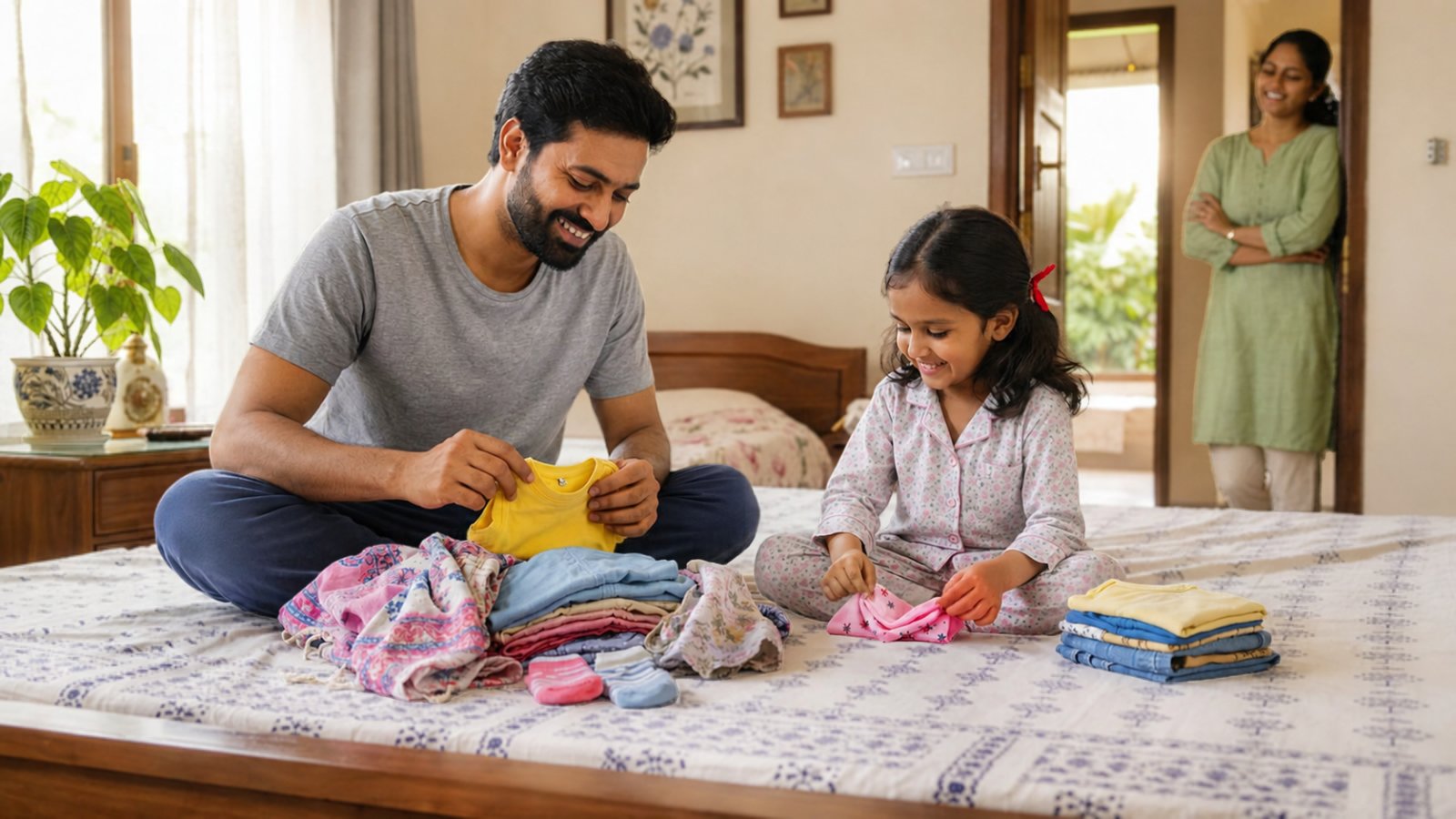
An example task split
Every family is different, so treat this as a starting template, not a rule. The key is that each task has one clear owner for the planning and the doing.
| Area | Partner A owns | Partner B owns |
|---|---|---|
| Meals | Weekly menu, grocery list and online ordering | Weekday cooking and tiffin packing; Partner A cooks on weekends |
| Children’s health | Doctor visits, vaccination dates, medicine cabinet | School forms, fees and uniforms |
| School runs | Morning drop-off | Evening pick-up and homework check |
| Home | Briefing the house help, laundry and ironing | Bills, repairs, cylinder and water refills |
| Family and social | Own side’s relatives, gifts and festival shopping | Own side’s relatives, travel bookings and party RSVPs |
| Bedtime | Alternate nights | Alternate nights |
Notice that each partner handles their own side of the family. That one rule removes a lot of silent resentment, because neither person is managing relationships on the other’s behalf.
Step 3: Hold a weekly sync
A short, regular check-in stops tasks from being renegotiated in the middle of a stressful evening. Pick a fixed 20 to 30 minutes, perhaps Sunday after the children sleep, and keep it practical and kind.
- Look ahead: check the week’s calendar for exams, festivals, travel and guests.
- Assign the unusual: decide who handles anything outside the regular split.
- Review what is not working: one task, one change, no blame.
- Say thank you: name one thing your partner did well this week.
A shared phone calendar or a shared notes list helps the plan live outside your head. If one person is still the keeper of all the dates, the load has not really moved. If you are short on time to begin with, our post on time management challenges every mom faces has ideas that fit well with this routine.
Working with domestic help and family
In many Indian homes, a cook, maid or nanny does a lot of the physical work. That helps, but it does not remove the mental load. Someone still has to hire, brief, pay, cover for absences and check that the work is done well.
Divide the managing, not just the chores
Decide who is the point person for the house help, and who is the backup on days that person is away. Agree rules together, such as leave days, payment dates and which tasks matter most, so the help is not given conflicting instructions.
Joint families and in-laws
If you live with parents or in-laws, sharing the load becomes a conversation with more people. A few things tend to help:
- Talk to your partner first, privately, so you arrive at the family conversation as a team.
- Let each partner raise issues with their own parents, rather than the daughter-in-law doing it.
- Be clear about what grandparents are glad to do, such as school pick-ups or story time, and thank them, rather than assuming.
- Agree that a new split in your own part of the home does not mean the elders’ help is unwelcome.
Change can feel uncomfortable for older family members who grew up with different roles. Go gently, and show through daily practice what shared parenting looks like.
Involve children in age-appropriate chores
Children are part of the household too, and small jobs build confidence and teach that housework belongs to everyone. UNICEF’s guidance on equity in household tasks advises that boys and girls share age-appropriate chores equally, that adults lead by example, and that children keep time for play and study. The UNICEF India parenting page likewise suggests letting young children learn all household chores and dividing responsibilities equally between boys and girls.
Here are some ideas by age. Every child is different, so adapt to your own and always keep tasks safe.
- Toddlers and preschoolers: putting toys in a basket, carrying their own plate, dropping dirty clothes in the laundry bin.
- Early school age: setting the table, watering plants, matching socks, packing their own school bag with a checklist.
- Older children: folding laundry, helping with simple cooking, laying out clothes for the week, keeping their own room tidy.
Check that you are not quietly giving daughters more work than sons. Children copy what they see, so when both parents cook, clean and care, the lesson sticks far better than any lecture. Chores should also never replace homework, play or rest. For more on building confidence in children, see our post on seven ways to build self-esteem in your child.
Avoid scorekeeping
When one person feels overloaded, the instinct is to count: “I did the bills, the school form and the doctor, and you did one grocery run.” Scorekeeping turns a shared project into a contest, and nobody wins.
Aim for fairness over a stretch of time, not a perfect tally each day. Some weeks one of you will have a deadline, a sick parent or a festival to organise, and the other will carry more. What matters is that the load rebalances and that both people feel seen.
- Talk about the load in terms of “us” and “the house”, not “you never”.
- Judge fairness by the whole picture, including mental effort, not only by hours.
- Raise problems early and calmly, using “I feel overwhelmed when…” instead of accusations.
- Remember that a partner who is learning will make mistakes. Praise the effort.
If you are a working mother carrying guilt on top of the load, you may relate to our post on the dilemma of being a working mom.
Common questions
What if my partner says “just tell me what to do”?
It is a kind offer, but it keeps you as the manager. Instead of giving instructions, hand over a whole area, such as “you own the children’s doctor visits from now on”, and let your partner work out the how.
What if we have very different standards of cleanliness?
Agree on a minimum standard together for each task, then let the owner decide the rest. If a gap remains, a shared budget for extra help can sometimes be easier than arguing about it.
We both work long hours. How can we make this fair?
Be honest about capacity and use outside help where you can, whether that is a cook, laundry service or grocery delivery. Then divide the managing of that help as carefully as the chores themselves.
Is this the same as being a perfect parent?
No. It is about a fairer home, not a flawless one. Some days will be messy, and that is part of family life.
Start small this week
You do not need to overhaul your home in a weekend. Pick one invisible task, such as the children’s health appointments or the weekly grocery plan, and hand it over completely to your partner for a month. Then hold your first weekly sync and see what worked.
Sharing household responsibilities is an ongoing conversation rather than a one-time deal. If the pressure feels heavy or leads to constant conflict, a family counsellor or therapist can help, and it is a sign of strength to ask. And when it starts to work, motherhood often gets lighter, as we explore in does motherhood get easier.
This article is general information, not professional counselling advice. If stress or conflict at home is affecting your health or relationship, please speak to a qualified professional.